Vatican Museums masterpieces
The Vatican Museums are kilometres of galleries and more than 20,000 works on display: impossible to see it all in one visit. That is why it helps to know what to look for. Beyond the Sistine Chapel and the Raphael Rooms, these are the must-sees you should not miss on the route, in roughly the order in which you will come across them.
Don't miss the essentials: go with a guide
A guide takes you straight to the key works and saves you from wandering endless galleries. Priority access, skip the line.
See the guided tour (from €62.10) →⏳ One of the world's most visited sites: tickets sell out in high season. Book ahead · free cancellation.
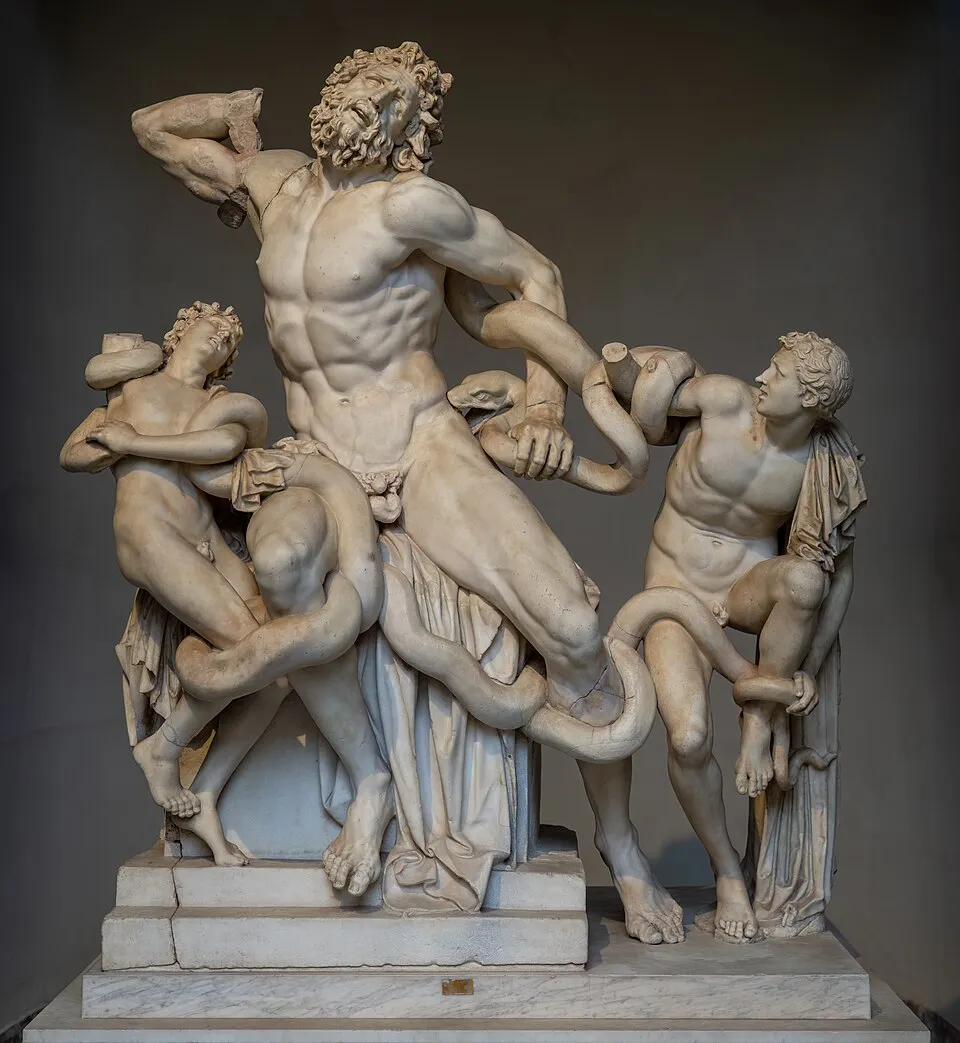
1. The Laocoön, the work that founded the museum
If the Vatican Museums exist, it is, in large part, thanks to this sculpture. The Laocoön is a Hellenistic group depicting the Trojan priest and his two sons trapped by the serpents sent by the gods. It was found in 1506 in a vineyard in Rome, above the remains of Nero's Domus Aurea. Pope Julius II bought it at once and displayed it in the Belvedere Courtyard: that gesture marked the birth of the papal collection. Its drama, its muscular tension and its anatomy deeply influenced Michelangelo. Today it presides over one of the niches of the Pio-Clementino Museum.
2. The Pio-Clementino Museum and the Apollo Belvedere
This set of rooms gathers the finest of the Vatican's classical sculpture. Besides the Laocoön, here is the celebrated Apollo Belvedere, regarded for centuries as the canon of male beauty; the Belvedere Torso, a fragment Michelangelo admired so much that he refused to restore it; and the majestic Round Hall, inspired by the Pantheon, with its huge red porphyry basin at the centre and a Roman mosaic on the floor. It is one of the most beautiful spaces on the route.
3. The Gallery of the Candelabra
A long gallery of ancient statues divided into sections by pairs of marble candelabra, with a fresco-decorated vault. It marks the start of the succession of galleries that lead, little by little, towards the Sistine Chapel.
4. The Gallery of the Tapestries
Here hang the great Flemish tapestries woven in Brussels from cartoons by Raphael's school, with scenes from the life of Christ. Look for The Resurrection: through an optical effect, Christ's gaze and the tomb's slab seem to follow you as you walk down the gallery. It is one of those details that surprises everyone.
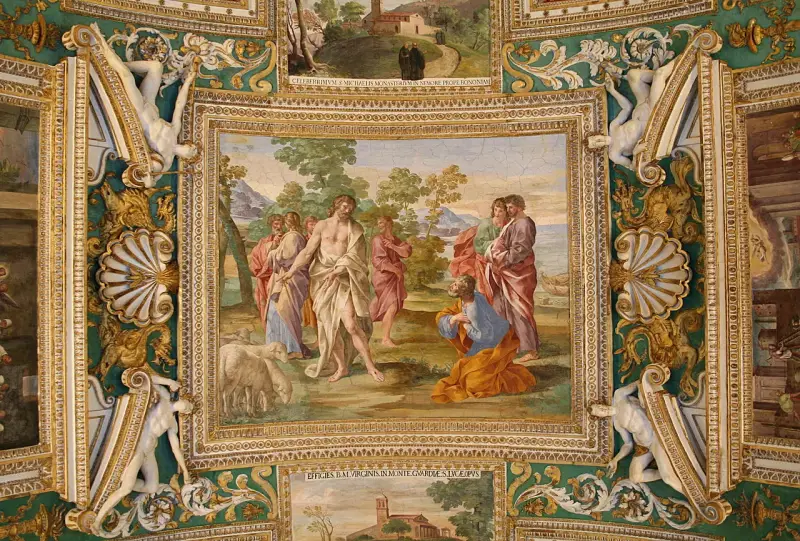
5. The Gallery of the Maps
For many, the most spectacular gallery in the whole Vatican. Along 120 metres, the walls show 40 frescoed maps of the regions of Italy, painted between 1580 and 1585 for Pope Gregory XIII. But what leaves you breathless is the golden ceiling, a succession of vaults with stuccoes and scenes that gleam above your head. It is one of the most photographed places on the route.
6. The Borgia Apartments
The former private rooms of Pope Alexander VI, of the famous Borgia family, decorated in fresco by Pinturicchio at the end of the 15th century. Their intense colours, their gilding and their somewhat quieter atmosphere offer a respite from the crowds. Today they also house part of the Vatican's Collection of Contemporary Art.
7. The Bramante Staircase (the one on the way out)
The grand finale. The famous double-helix staircase photographed from above — two intertwined ramps that never meet — is the work of Giuseppe Momo (1932) and is found at the exit of the museums. It takes its name from an earlier staircase by Bramante, located in another area and not accessible to the general public. It is the image with which almost everyone says goodbye to the Vatican.
And also, without entering the galleries
- Courtyard of the Pinecone: with the colossal Roman bronze pinecone and the rotating Sphere within Sphere by Arnaldo Pomodoro at the centre.
- Vatican Pinacoteca: with Raphael's last work, the Transfiguration, and the unfinished Saint Jerome by Leonardo da Vinci.
- Gregorian Egyptian Museum and Etruscan Museum: for those with time who want to step off the main circuit.
Walk through it well and skip the line
Book your access to the Vatican and the Sistine Chapel with instant confirmation and free cancellation.
Book the guided tour →Prefer to go on your own? Skip-the-line ticket from €62.10 →
Frequently asked questions
What must you see?
The Sistine Chapel, the Raphael Rooms with The School of Athens, the Laocoön, the Gallery of the Maps, the Tapestries, the Borgia Apartments, the Pio-Clementino Museum with the Apollo Belvedere, and the Bramante Staircase on the way out.
What is the Laocoön?
A Hellenistic sculptural group found in Rome in 1506. Julius II acquired it that same year and with it the Vatican Museums were in effect born. It is displayed in the Pio-Clementino Museum.
Can you photograph the Bramante Staircase?
Yes, like almost all of the museum. Only in the Sistine Chapel is photography forbidden.
How long does it take to see it all?
The essential route to the Sistine Chapel takes about 2.5-3 hours. Seeing it at leisure, including the Pinacoteca and the secondary museums, can take half a day or more.
Keep exploring the Vatican
Last updated: July 2026. The works are in the public domain; the images are reproductions.