Raphael Rooms and The School of Athens
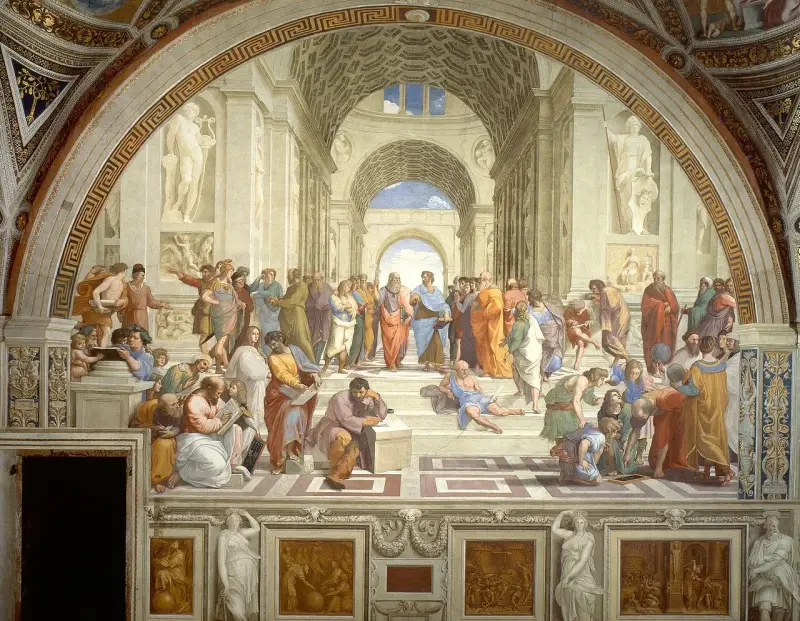
Before reaching the Sistine Chapel, the route through the Vatican Museums passes through four rooms painted by Raphael and his workshop for Pope Julius II. In one of them is The School of Athens, the fresco that best sums up the spirit of the Renaissance: classical Antiquity gathered into a single space, with Plato and Aristotle at the centre. Here we tell you what to look for and where Raphael himself hid.
Walk through the Rooms and the Sistine Chapel with a guide
The guide takes you straight to the essentials and explains The School of Athens before you enter the Sistine Chapel. Priority access, skip the line.
See the guided tour (from €62.10) →⏳ One of the world's most visited sites: tickets sell out in high season. Book ahead · free cancellation.
What the Raphael Rooms are
The Rooms were the private apartment of Pope Julius II in the Apostolic Palace. In 1508, the same year Michelangelo was beginning the Sistine ceiling a few metres away, the pope commissioned a 25-year-old newcomer from Urbino — Raphael — to decorate these rooms. Raphael and his workshop worked on them between 1508 and 1524 (the painter died in 1520, and his pupils finished the work). There are four:
- Room of the Segnatura: the first and most famous, the pope's former study-library. Here are The School of Athens (philosophy), the Disputation of the Holy Sacrament (theology), the Parnassus (poetry) and the Cardinal Virtues (law).
- Room of Heliodorus: with the dramatic Expulsion of Heliodorus from the Temple and the Mass at Bolsena.
- Room of the Fire in the Borgo: named after its main fresco, a fire halted by the pope's blessing.
- Room of Constantine: the largest, dedicated to the first Christian emperor and completed for the most part by the workshop after Raphael's death.
The School of Athens: the heart of the Renaissance
Painted around 1509-1511 in the Room of the Segnatura, The School of Athens gathers the great thinkers of Antiquity beneath a majestic classical architecture — inspired by Bramante's design for the new St Peter's Basilica. It is not a real historical scene but an ideal homage to reason and human knowledge. The composition, perfectly balanced and built with impeccable perspective, draws the eye towards the two central figures.
Plato and Aristotle, at the centre
Beneath the central arch advance the two philosophers who sum up the whole work. Plato, elderly, holds his Timaeus and points to the sky: the world of ideas, the eternal. Beside him, Aristotle, younger, carries his Ethics and extends his hand towards the earth: knowledge of the concrete and the observable. In that opposing gesture is condensed the history of Western thought. It is also believed that Raphael gave Plato the features of Leonardo da Vinci, whom he admired.
The other philosophers: who's who
- Socrates, on the left, counting out his arguments on his fingers before a group listening to him.
- Diogenes, the Cynic, sprawled carelessly on the steps.
- Heraclitus, pensive and leaning on a block of stone in the foreground: Raphael is thought to have given him the face of Michelangelo, who was painting the Sistine ceiling next door at the time.
- Pythagoras, at the lower left, writing in a book surrounded by disciples.
- Euclid (or Archimedes), bent over with a compass, tracing a geometric figure; he is said to have the face of the architect Bramante.
- Ptolemy and Zoroaster, each with a sphere — terrestrial and celestial — on the right.
Raphael's self-portrait
Beside the group on the right, leaning to the edge of the fresco and looking directly at the viewer, is Raphael himself. He is the young man in the dark cap, almost hidden behind Ptolemy and Zoroaster, beside another painter (often identified as Sodoma or Perugino). It is his discreet signature: the artist includes himself among the sages, but at the back, without prominence. Spotting him is one of the little games that visitors to the room most enjoy.
What to look for when you enter
- The opposing gestures of Plato (to the sky) and Aristotle (to the earth) beneath the central arch.
- The gaze of Raphael towards the viewer, at the lower right.
- The Heraclitus with Michelangelo's face, in the foreground, added by Raphael almost at the end.
- The perspective of the architecture, which directs all attention to the vanishing point between the two philosophers.
- Opposite, the Disputation of the Holy Sacrament: philosophy and theology, reason and faith, facing each other in the same room.
See it in person, without the wait
The Raphael Rooms are included on the route. Book your access to the Vatican with instant confirmation and free cancellation.
Book the guided tour →Prefer to go on your own? Skip-the-line ticket from €62.10 →
Frequently asked questions
What are the Raphael Rooms?
Four rooms of the Apostolic Palace that Raphael and his workshop decorated in fresco between 1508 and 1524 for Julius II. They are visited on the route through the Vatican Museums, shortly before the Sistine Chapel.
Who are Plato and Aristotle in The School of Athens?
At the centre, Plato points to the sky (the world of ideas) and Aristotle extends his hand towards the earth (knowledge of the concrete). Raphael is believed to have given Plato the features of Leonardo da Vinci.
Where is Raphael in The School of Athens?
He painted his self-portrait at the far right, looking at the viewer, beside other painters. He is a young man in a dark cap, almost hidden in the group on the right.
Do you see the Rooms with a Vatican Museums ticket?
Yes. They are part of the normal route and are included in any ticket or guided tour. They are located shortly before the Sistine Chapel.
Keep exploring the Vatican
Last updated: July 2026. The works are in the public domain; the images are reproductions.