The Creation of Adam
Two hands about to touch, a spark suspended in the air: The Creation of Adam is, probably, the most reproduced image in the history of art. Michelangelo painted it around 1511 at the centre of the Sistine Chapel ceiling, and ever since it has never stopped fascinating theologians, historians, doctors and travellers. This is what you are looking at when you raise your eyes.
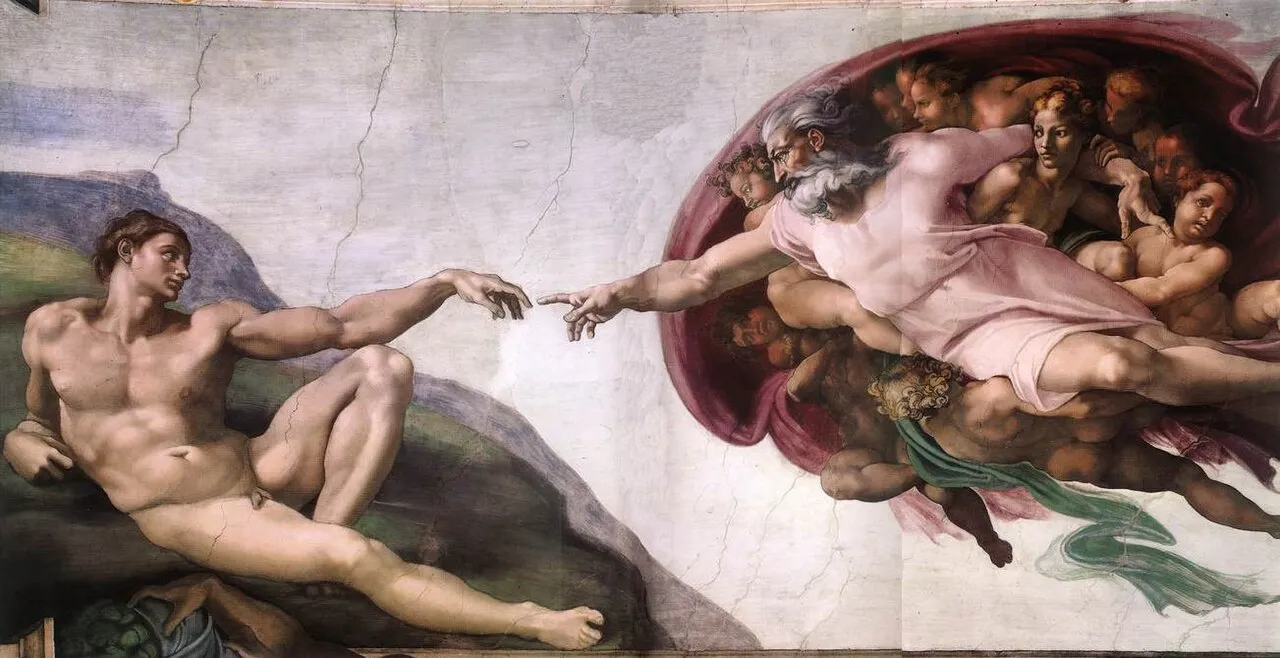
Public-domain reproduction. ⚠️ Photography is forbidden in the Sistine Chapel; this image is not a photo of the interior.
Where it is and what it depicts
The Creation of Adam occupies the fourth of the nine central panels of the Sistine Chapel ceiling, within the Genesis cycle that Michelangelo painted between 1508 and 1512. The scene illustrates the moment when God breathes life into the first man. On the left, Adam lies nude on the earth, languid and still without strength, and reaches out his arm listlessly. On the right, God the Father arrives in flight, wrapped in a cloak and surrounded by angels, and stretches his arm towards him with energy. Between the two index fingers a tiny gap remains: life is about to be transmitted, but not yet.
The stroke of genius: the hands that do not touch
Michelangelo's great insight was precisely not to let the hands touch. That small gap between the fingers concentrates all the tension of the fresco. It suggests the instant before the spark of life and, for many, also human freedom: Adam will be able to draw nearer to or away from God. God's hand appears taut and active; Adam's, relaxed and passive, still waiting. It is one of those artistic decisions that change the history of the image.
Look at the ceiling with someone who knows how to read it
On a guided tour you are walked through The Creation of Adam and the whole ceiling before entering the Sistine Chapel, where you must keep silence. Priority access, skip the line.
See the guided tour (from €62.10) →⏳ One of the world's most visited sites: tickets sell out in high season. Book ahead · free cancellation.
The brain theory
In 1990, the American physician Frank Lynn Meshberger published an observation that went around the world: the reddish cloak enveloping God and the figures accompanying him reproduces, with astonishing precision, the silhouette of a human brain seen in cross-section. One can make out the brainstem, the cerebellum, the basilar artery and even the pituitary gland. According to this reading, Michelangelo — who dissected cadavers and mastered anatomy like few others — may have wished to suggest that the divine gift to Adam was, above all, intelligence.
There is no document confirming that it was intentional, and many specialists consider it a suggestive coincidence. But the idea has taken hold, and today it is one of the great talking points in front of the fresco. Later studies have seen similar anatomical figures in other scenes on the ceiling, which keeps the debate alive.
Who the figure beside God is
Under God's left arm, within the cloak, a female figure shelters, looking towards Adam, beside a child. Her identity has been debated for centuries. The most widely accepted hypotheses see her as Eve — not yet created, but already present in the divine mind — or as the Virgin Mary, in which case the child would be the future Christ, anticipating the Redemption in the very act of Creation. Whoever she is, her gaze visually connects heaven with earth.
Curiosities of the fresco
- He painted it lying on his back… is a half-myth. Michelangelo worked standing on a raised scaffold, with his head tilted back, not lying down. He left a verse describing how much his body suffered from the posture.
- Adam's navel. Adam appears with a navel, which gave rise to an old theological debate: should the first man have one, if he was not born of a woman?
- A revealing restoration. The 1980-1994 cleaning removed centuries of soot and varnish and restored to the scene colours far more vivid than had been believed.
- The missing finger. Adam's index finger was retouched in an old restoration; a small fragment of the original fresco had been lost.
- Pop icon. The two hands have become one of the most imitated visual symbols on the planet, from advertising to cinema.
See it in person, without the wait
Book your access to the Vatican and the Sistine Chapel with instant confirmation and free cancellation.
Book the guided tour →Prefer to go on your own? Skip-the-line ticket from €62.10 →
Frequently asked questions
Why don't the hands of God and Adam touch?
Michelangelo deliberately left a tiny gap between the two fingers. That spark of tension evokes the instant before life is transmitted and the human freedom to draw closer to or away from God.
Is it true that the figure of God has the shape of a brain?
It is a theory shared since 1990: the cloak surrounding God reproduces with remarkable precision the silhouette of a human brain. Michelangelo knew a great deal of anatomy. There is no proof that it was intentional, but the resemblance is striking.
Who is the woman God embraces?
It is debated. The most widely accepted hypotheses identify her with Eve, not yet created, or with the Virgin Mary; in that case the child would be the future Christ.
Where is The Creation of Adam?
At the centre of the Sistine Chapel ceiling, in the Vatican Museums. You see it by looking up. The chapel is visited at the end of the route through the museums.
Keep exploring the Vatican
Last updated: July 2026. The work is in the public domain; the image is a reproduction, not a photograph of the interior of the Sistine Chapel, where photography is forbidden.