The Sistine Chapel
It is the end of the route through the Vatican Museums and, for millions of travellers, the real reason for the trip. Beneath the ceiling Michelangelo painted between 1508 and 1512, and facing the colossal Last Judgment, the Sistine Chapel concentrates the summit of Renaissance painting into a hundred or so square metres of ceiling and a single altar wall. Here we explain what you are looking at, what to seek out and how to prepare for a room where talking and taking photos are forbidden.
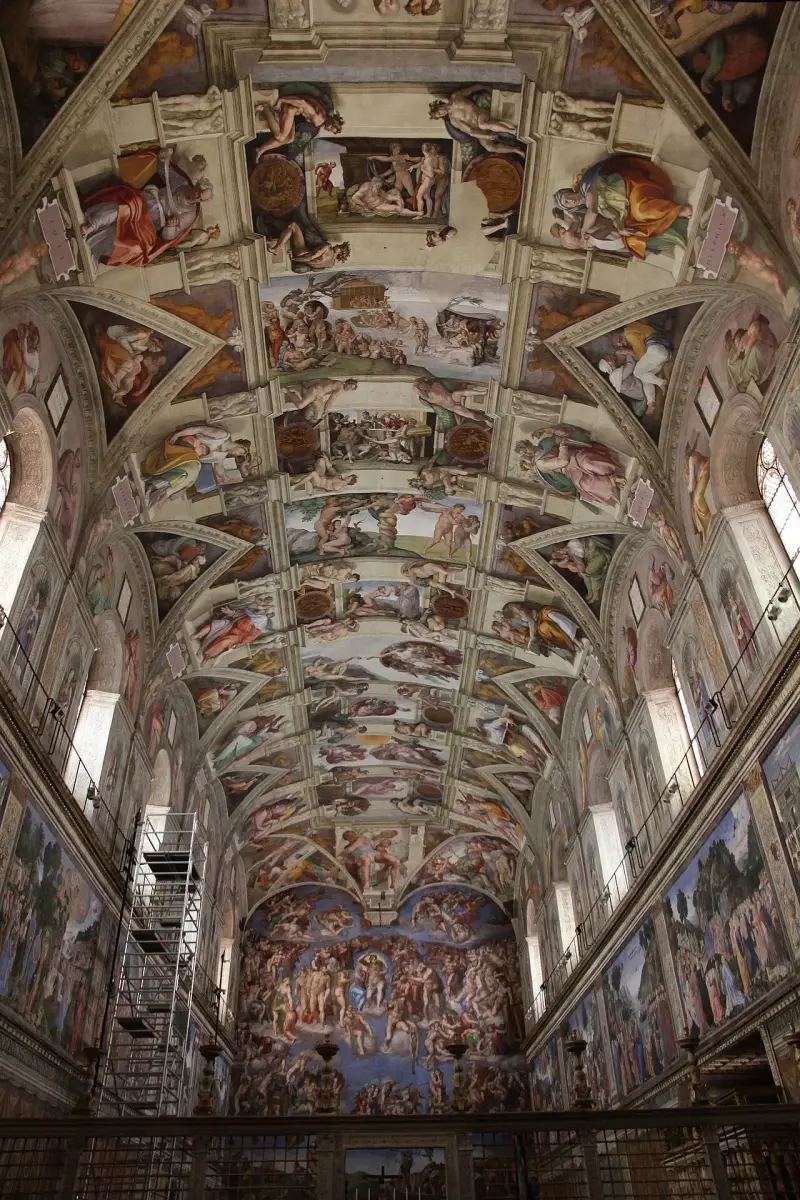
Public-domain reproduction of Michelangelo's ceiling. ⚠️ Photography is forbidden inside the Sistine Chapel: the images on this page are reproductions of the works, not photos of the interior.
Enter the Sistine Chapel skip-the-line, with a guide who explains it beforehand
Inside you must keep silence: ideally you understand everything before you cross the threshold. Priority access · Guided commentary · Free cancellation.
See the guided tour (from €62.10) →⏳ One of the world's most visited sites: tickets sell out in high season. Book ahead · free cancellation.
What the Sistine Chapel is
The Sistine Chapel is the principal chapel of the Apostolic Palace, the Pope's official residence in the Vatican. Its name comes from Pope Sixtus IV, who had it built between 1473 and 1481 with proportions that echo those of the Temple of Solomon described in the Bible. It is not only an artistic jewel: it remains a sacred space in use, and it is here that the conclave that elects each new pontiff gathers. That is why, amid the crowds, the wardens repeatedly remind visitors that this is a place of worship and ask for silence.
The side walls were decorated first, in the 1480s, with two facing cycles of frescoes — the life of Moses and the life of Christ — painted by the finest artists of the day: Botticelli, Perugino, Ghirlandaio, Rosselli and their workshops. But what makes the chapel famous across the world today came later, from the hand of a single man: Michelangelo Buonarroti.
Michelangelo's ceiling (1508-1512)
In 1508 Pope Julius II commissioned Michelangelo to repaint the ceiling, which until then had shown a simple starry sky. The artist — who considered himself above all a sculptor and accepted the commission almost reluctantly — worked for four years on a raised scaffold, in gruelling conditions: painting in fresco on the wet plaster, head tilted back and neck strained through endless days. The result was one of the most astonishing feats in the history of art.
Across more than 500 square metres, Michelangelo laid out a grand programme from the Book of Genesis. Along the central axis run nine scenes that move from the Creation of the world to the Drunkenness of Noah: the separation of light from darkness, the creation of the heavenly bodies, the creation of Adam, the creation of Eve, the Fall and the expulsion from Paradise, the Flood… Around them, seated on architectural thrones, the imposing Prophets and Sibyls announce the coming of Christ, and in the corners and lunettes appear the ancestors of Jesus and episodes of the salvation of the people of Israel.
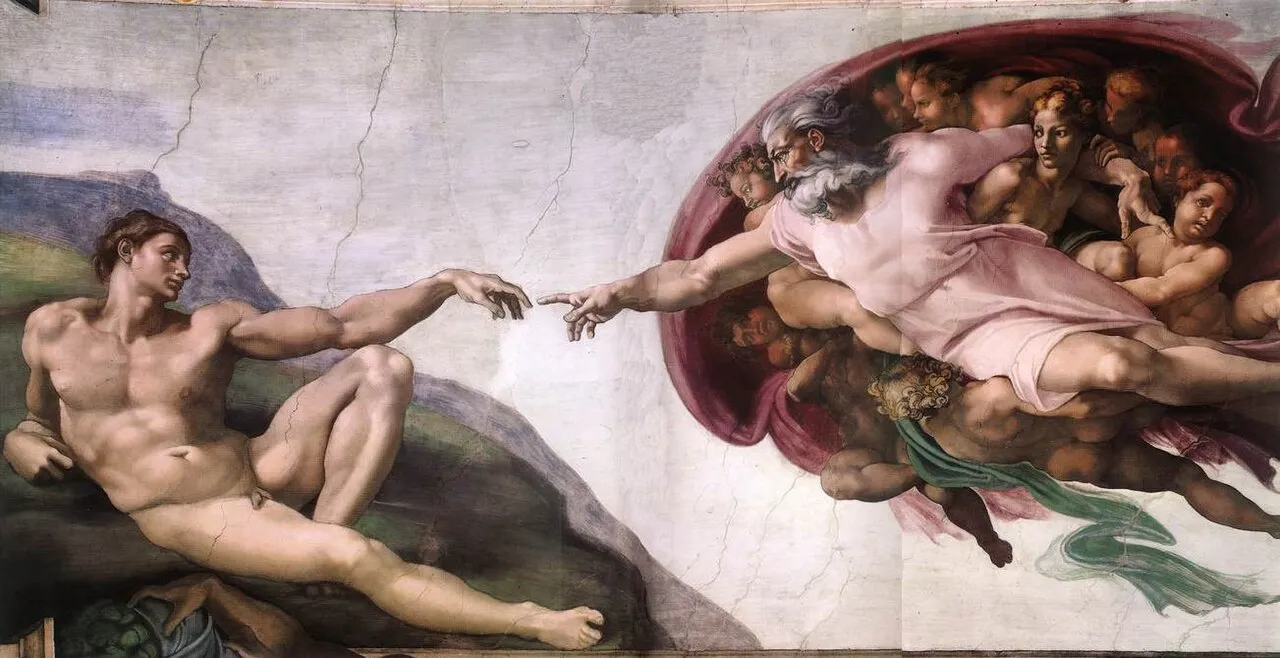
The undisputed centre of the whole ensemble is The Creation of Adam, with the two hands — God's and Adam's — about to touch. It is probably the most reproduced image in the history of art. We devote a dedicated page to it, with its meaning and its curiosities.
Read more about The Creation of Adam →
The Last Judgment (1536-1541)
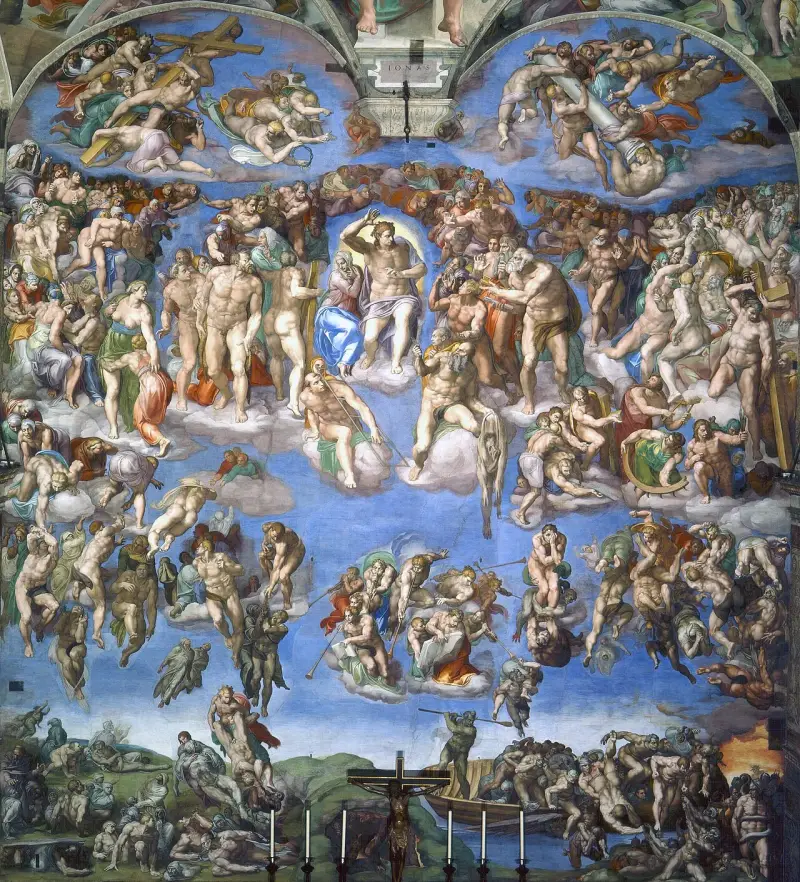
Almost a quarter of a century after finishing the ceiling, Michelangelo — by then in his sixties — returned to the chapel to paint the enormous fresco that covers the entire altar wall: The Last Judgment. It was commissioned by Popes Clement VII and Paul III at a turbulent time, with Rome still scarred by the sack of 1527 and Christianity divided by the Protestant Reformation. The work reflects that dramatic climate.
At the centre, a young, athletic, beardless Christ the Judge raises his arm in a gesture that sets the whole composition in motion: to his right the blessed rise towards heaven, to his left the damned plunge into hell. At his feet, the Virgin turns her gaze away. More than 300 nude, twisting, muscular figures swirl in a vortex without the usual ordering into planes: a universe in motion where no architectural framework holds anyone up.
The fresco was as revolutionary as it was controversial. The abundance of nudes scandalised part of the Curia; years after Michelangelo's death, the painter Daniele da Volterra was commissioned to cover some figures with drapery, which earned him the mocking nickname il Braghettone ("the breeches-maker"). There are fascinating details to seek out: in the flayed skin held by Saint Bartholomew, many recognise a distorted self-portrait of Michelangelo himself; and among the damned slips Minos with donkey's ears, in whom tradition sees the caricature of a censor who had criticised the work.
Why it matters so much
The Sistine Chapel condenses two decisive moments of the Renaissance into a single space. The ceiling (1508-1512) represents the luminous balance and confidence in humankind of the High Renaissance; The Last Judgment (1536-1541), painted by the same artist a generation later, foreshadows the tension, dynamism and drama of Mannerism and the Baroque. Being able to read that evolution in two works by the same genius, one facing the other, has no equal.
Add to that its historical weight: each pope is chosen here, the mastery of fresco is measured here, and much of the image the West has of the divine was forged here. The 1980-1994 restoration, which returned the frescoes to their original colours — far more vivid than had been believed — was one of the great cultural events of the 20th century.
What to look for when you enter
- The Creation of Adam, at the centre of the ceiling: the tiny gap between the two fingers.
- The Prophet Jonah, above the altar: a feat of perspective, leaning back exactly where the ceiling curves.
- The Sibyls and Prophets on their thrones, among them the celebrated Delphic Sibyl and the brooding Jeremiah.
- Christ the Judge in The Last Judgment and, below him, Michelangelo's self-portrait in the skin of Saint Bartholomew.
- Charon's boat and the figure of Minos with donkey's ears, at the lower right of the Judgment.
- The 15th-century frescoes by Botticelli and Perugino on the side walls, which almost everyone overlooks.
Rules: silence and no photography
The Sistine Chapel is the room with the strictest rules in the entire Vatican, and it is worth knowing them before you go in:
- Absolute silence. It is a place of worship. Staff regularly call for silence and appreciate it when visitors do not talk.
- No photography or filming. Photos and videos are not allowed, with or without flash. (In the rest of the Vatican Museums you may photograph without flash.)
- Dress code. As throughout the route, you must have your shoulders and knees covered.
- You may not sit on the floor or lean against the walls; there are continuous benches along the sides.
This is why a guided tour is so practical: the guide explains the ceiling and The Last Judgment before you go in, in an adjoining room, so that once inside you only have to look and enjoy in silence.
How you reach the Sistine Chapel
This is the point that confuses travellers most: the Sistine Chapel has no entrance of its own. It lies at the end of the route through the Vatican Museums, so to visit it you must first enter the museums and walk through them. Any ticket or guided tour of the Vatican Museums therefore includes the Sistine Chapel.
The usual path runs through the Gallery of the Candelabra, the Gallery of the Tapestries, the spectacular Gallery of the Maps and the Raphael Rooms, before descending a staircase to the chapel. From the Sistine Chapel, a shortcut to the right of the altar (reserved for guided groups) leads directly to St Peter's Basilica without having to retrace the whole route or queue again.
Experience it well: skip the line and with a briefing first
Book priority access and a guide who prepares you for the Sistine Chapel. Instant confirmation and free cancellation.
Book the Vatican guided tour →Prefer to go on your own? Skip-the-line ticket from €62.10 →
Tips from our visit to the Sistine Chapel
The Ticket Visit team has walked the Vatican Museums all the way to the Sistine Chapel; these are the tips you'll appreciate most once you're inside.
- Keep silence. It is a sacred space and the guards regularly call for "silenzio"; speaking softly or staying quiet lets you enjoy the ceiling in peace.
- No photos allowed. Photography and filming are forbidden inside the chapel: put your phone away and take it in with your own eyes.
- Sit on the side benches. If there's room, rest on the benches along the walls to admire the ceiling without straining your neck looking up.
- Pace your energy. The chapel is the end of the route: don't wear yourself out in the earlier galleries so you arrive with energy for the best part.

Every price, opening time and tip in this guide is checked against the Civitatis listing and Vatican sources before it is published. Last reviewed: September 2026. Been to the Vatican? Tell us about your visit →
Frequently asked questions
Can you visit only the Sistine Chapel?
No. The Sistine Chapel has no independent access: you reach it at the end of the route through the Vatican Museums. Every ticket or guided tour of the Museums includes the Sistine Chapel.
Can you take photos in the Sistine Chapel?
No. Photography and filming are forbidden in the Sistine Chapel, and you must keep silence. In the rest of the Vatican Museums you may take photos without flash.
Who painted the Sistine Chapel?
Michelangelo painted the ceiling between 1508 and 1512 and The Last Judgment between 1536 and 1541. The side walls had been decorated earlier by Botticelli, Perugino, Ghirlandaio and Rosselli, among others.
How long can you stay inside?
There is no official limit, but as it is the last room on the route and always busy, most people stay between 10 and 20 minutes. Go in calmly and do not rush to leave.
Do you have to walk through the whole museum to reach it?
Yes. The Sistine Chapel is at the end of the route; before it you pass through galleries such as the Maps and the Raphael Rooms. With a guide there is a direct access to St Peter's Basilica from the chapel itself.
Why are photos forbidden?
For conservation reasons and because of the rights to the 1980s-90s restoration, which was funded by a television company in exchange for the image rights. The rule still stands today; the guards ask for silence and no photos.
Where is the Sistine Chapel on the route?
At the end of the Vatican Museums itinerary, after the Raphael Rooms. It has no entrance of its own: you reach it by following the signposted route.
Keep exploring the Vatican
Last updated: July 2026. The works described are in the public domain; the images are reproductions, not photographs of the interior of the Sistine Chapel, where photography is forbidden.